


Sir Hugh Lane (1875–1915) was a renowned Irish art dealer, collector, and gallery director who established Dublin’s Municipal Gallery of Modern Art (now the Hugh Lane Gallery) in 1908. A key figure in the Irish cultural revival, he championed Impressionist art and was knighted in 1909 for his contributions. Lane died at the age of 39 during the sinking of the RMS Lusitania on May 7, 1915. At the time, he was one of the wealthiest men in Ireland, transporting valuable paintings to New York.

Photograph of Sir Hugh Lane.
On the same evening of May 7, 1915, Hester Travers Smith (1868–1949), a prominent medium from Dublin, Ireland, sat at a Ouija board with playwright Lennox Robinson (1886 – 1958) and Reverend Savell Hicks (1878 – 1962). During their session, they received a message stating, “Pray for Hugh Lane.” The participants complied, and after the prayer, the board spelled out, “I am Hugh Lane, all is dark.”
Though Travers Smith was aware of the sinking, she and the others were unaware that Lane was a passenger on the ill-fated ship. Through the Ouija board, Lane described the panic that ensued, explaining that lifeboats were lowered and that women were evacuated first. He shared that he was the last to board an overcrowded lifeboat, which ultimately capsized, throwing its occupants into the sea. He stated that he remembered nothing until he “saw a light” during their sitting, adding, “I did not suffer. I was drowned and felt nothing.”
To verify his identity, Lane recounted the last time he had met Travers Smith. However, when she asked for his cabin number on the ship, the number he provided was later found to be incorrect. Travers Smith reasoned that it is not uncommon for people to forget their cabin numbers or to remember their cabins’ locations without knowing the numbers. Lane also conveyed intimate messages to his friends in Dublin.
In subsequent sittings, Travers Smith recounted that Lane implored her to inform people that he did not want a memorial gallery established in his honour. Instead, he wanted the codicil to his will to be honoured. Since the codicil had not been witnessed, the London gallery refused to relinquish the collection.
“Those pictures must be secured for Dublin,” Lane communicated on January 22, 1918, expressing that he could not rest until they were.
Sir William Barrett, a professor of physics at the Royal College in Dublin, conducted tests on the Ouija board sessions using various eye patches and blindfolds, as well as different board orientations and configurations, yet still produced coherent messages.
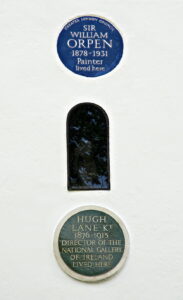
A Blue Plaque to Sir William Orpen and a Green Plaque to Hugh Lane on the wall of Oriel, Chelsea, the home they both shared for a time.
Article reproduced with kind permission from Thomas Sheridan
Post by Dominic Lee, Orpen Research Archives.